After Google I/O, Latency Became a Product Feature
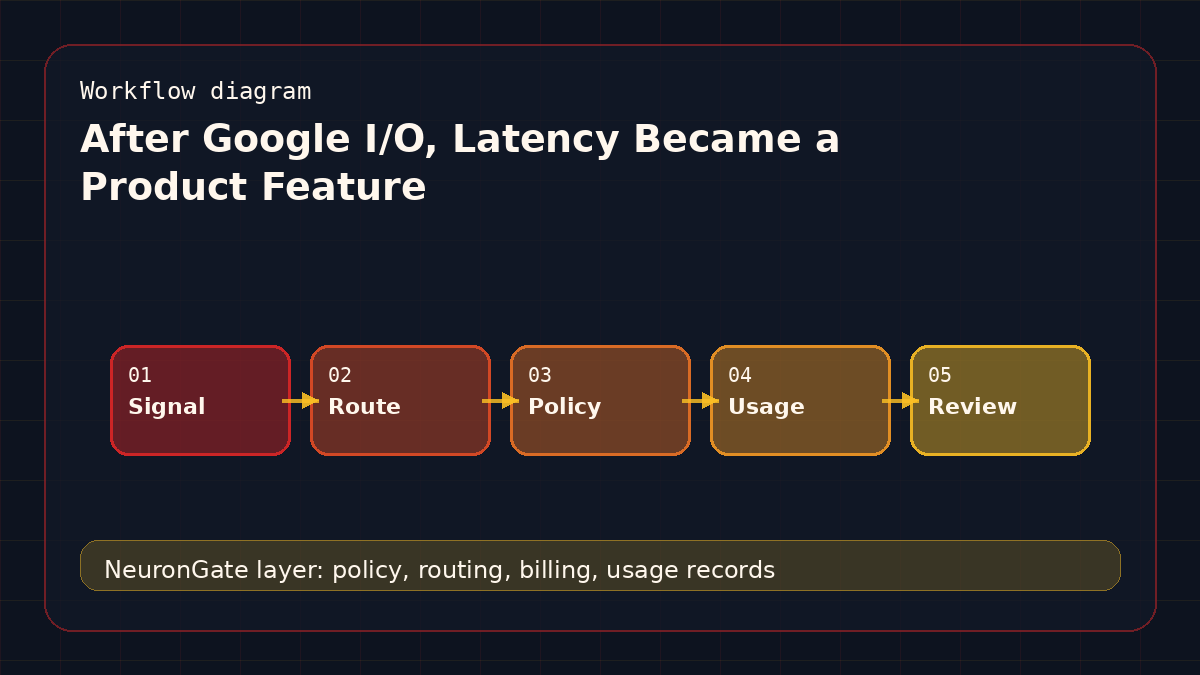
Google I/O made the AI roadmap feel more multimodal, more real-time, and more integrated into everyday software. The demos were polished, but the infrastructure lesson was plain: latency is no longer just an engineering metric. It is a product feature.
For developers building AI APIs, this matters as much as model quality. A model that is excellent at a benchmark can still be the wrong default if it makes the user wait. A cheaper model can still be expensive if slow responses reduce conversion. A fast model can be the right front door even when a stronger model sits behind it for escalations.
Fast models change interaction design
Gemini Flash-style models are not only useful because they cost less. They enable different product patterns. You can classify, rewrite, moderate, or draft while the user is still in flow. You can use a quick model to decide whether a heavier model is necessary. You can return partial value before running deeper analysis.
This creates a layered architecture:
- fast model for routing and first-pass responses
- stronger model for difficult reasoning
- specialized model for multimodal or long-context work
- fallback model when the preferred provider is degraded
A single API key should be able to access that stack without the application becoming a maze of provider-specific SDKs.
Latency belongs in the model catalogue
Most model catalogues emphasize context window and price. Those matter, but production teams also need to know how a model behaves under load. Time to first token, stream stability, timeout rate, and regional availability can matter more than a small quality difference.
We expect model catalogues to become more operational. Developers will ask not only "which model is smartest?" but also:
- which model is fast enough for this screen?
- which one is stable enough for a cron job?
- which one should be used as fallback?
- which one fits a user's remaining balance?
Multimodal raises the stakes
As multimodal requests become common, request sizes and failure modes change. Images, audio, and long documents create different constraints from plain text. They need clear limits, predictable errors, and billing that does not surprise the developer after upload.
The gateway layer should make those constraints visible. It should reject requests that are too large before forwarding them. It should normalize errors from upstream providers. It should record enough metadata for the developer to understand what happened.
The practical takeaway
The post-I/O model market is not only about smarter outputs. It is about choosing the right speed for the job. NeuronGate's direction is to make that choice easier: expose model options through a stable API, keep usage visible, and let teams build product flows that treat latency as a first-class decision.
Signals to watch next
The useful follow-up is not whether the announcement stays popular for a week. Watch whether provider pricing changes, whether aliases move, whether rate limits tighten, and whether customers ask for access by name. Those signals show when a news event has become product demand.
Teams should also watch support tickets. If customers ask why they cannot call a model, why an answer changed, or why one request costs more than another, the gateway needs clearer policy and better public documentation.
Editorial position
NeuronGate should treat news as operational context, not hype. A model release, compliance deadline, developer framework, or infrastructure announcement only matters when it changes how teams route, bill, observe, or explain AI work.
FAQ
Does this news require an immediate migration?
Usually no. The better response is to add the event to the evaluation backlog, map the affected workloads, and test behind controlled keys before changing defaults.
How does this help search visibility?
News-aware articles give Google and AI answer engines dated context around specific model and infrastructure events. That is stronger than generic evergreen copy because it shows freshness, source awareness, and product interpretation.
Why this mattered in May 2025
The news value of After Google I/O, Latency Became a Product Feature was operational, not just narrative. Teams could read Google I/O 2025 developer keynote and Gemini API I/O 2025 updates and understand the announcement, but builders needed a second layer: what changes in routing, policy, billing, and customer communication. The central concern was multimodal latency, high-throughput tiers, and real-time user experience. That is why this article frames the event through gateway operations instead of treating it as another model-market headline.
The practical risk was that an impressive multimodal route creates slow interactive experiences because every media step uses the same model. A strong gateway response is measured by time to first token, media preprocessing time, p95 latency, step count, and cost per completed multimodal task. That gives the product latency owner a way to decide whether the event requires a catalog update, a customer notice, an internal evaluation, or no immediate production change.
Editorial filter
NeuronGate should not chase every announcement. It should cover the events that change how teams build AI products: new model access, provider deprecation, pricing movement, latency changes, compliance pressure, and infrastructure shifts. After Google I/O, Latency Became a Product Feature qualifies because it gives buyers and engineers a dated reason to review their AI API operating model.
The publication note is simple: keep the date visible, link the source, state the operational takeaway early, and connect the story to a concrete routing or logging action. A practical next step is to compare routes in the model catalog, wire one request through the docs, then review the request path in the routing guide.