Google I/O 2026 Pushed Multimodal Routing Forward
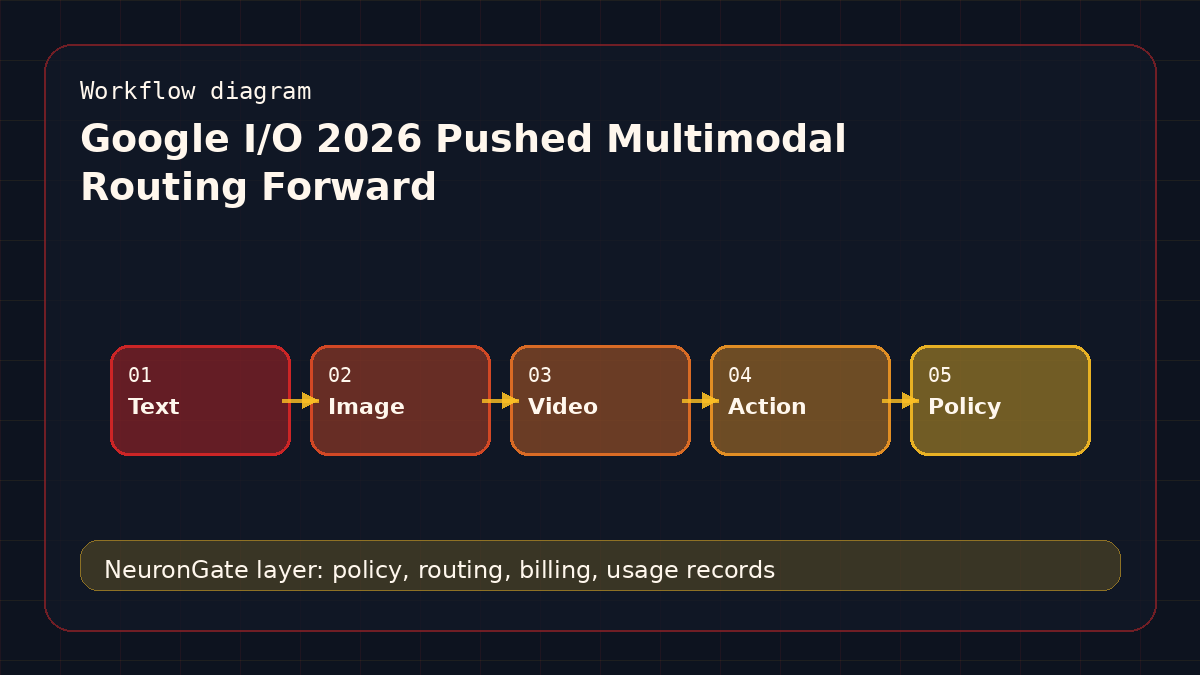
Google I/O 2026 moved multimodal routing from feature demo to product architecture. In May 2026, this mattered because models that create from any input and act across workflows need modality-aware pricing and policy. The practical response was simple: label each route by input type, output type, action ability, latency target, and approval level.
What happened
Google I/O 2026 moved multimodal routing from feature demo to product architecture. The important news was not only the headline itself. It was the operational shape behind it: models that create from any input and act across workflows need modality-aware pricing and policy. For an AI product team, that means the release should be evaluated as a routing, billing, and reliability event.
Why builders cared
A news event becomes important when it changes the default assumptions inside a product. In this case, teams had to revisit how they compare models, how they expose access to customers, and how quickly they can respond when a provider changes pricing, names, limits, or behavior.
The operating lesson
Label each route by input type, output type, action ability, latency target, and approval level. Teams that already had central model policy could respond with a catalog update and a measured rollout. Teams with model strings scattered across services had to search repositories, rebuild clients, and explain inconsistent usage records later.
NeuronGate angle
NeuronGate can keep multimodal model access governed while developers keep one API shape. Use the model catalog to compare available routes and pricing; use the docs to start integration work; use the articles archive to browse more model and infrastructure context.
Signals to watch next
The useful follow-up is not whether the announcement stays popular for a week. Watch whether provider pricing changes, whether aliases move, whether rate limits tighten, and whether customers ask for access by name. Those signals show when a news event has become product demand.
Teams should also watch support tickets. If customers ask why they cannot call a model, why an answer changed, or why one request costs more than another, the gateway needs clearer policy and better public documentation.
Editorial position
NeuronGate should treat news as operational context, not hype. A model release, compliance deadline, developer framework, or infrastructure announcement only matters when it changes how teams route, bill, observe, or explain AI work.
FAQ
Does this news require an immediate migration?
Usually no. The better response is to add the event to the evaluation backlog, map the affected workloads, and test behind controlled keys before changing defaults.
How does this help search visibility?
News-aware articles give Google and AI answer engines dated context around specific model and infrastructure events. That is stronger than generic evergreen copy because it shows freshness, source awareness, and product interpretation.
Why this mattered in May 2026
The news value of Google I/O 2026 Pushed Multimodal Routing Forward was operational, not just narrative. Teams could read Google I/O 2026 news and Google I/O 2026 developer keynote and understand the announcement, but builders needed a second layer: what changes in routing, policy, billing, and customer communication. The central concern was multimodal latency, high-throughput tiers, and real-time user experience. That is why this article frames the event through gateway operations instead of treating it as another model-market headline.
The practical risk was that an impressive multimodal route creates slow interactive experiences because every media step uses the same model. A strong gateway response is measured by time to first token, media preprocessing time, p95 latency, step count, and cost per completed multimodal task. That gives the product latency owner a way to decide whether the event requires a catalog update, a customer notice, an internal evaluation, or no immediate production change.
Editorial filter
NeuronGate should not chase every announcement. It should cover the events that change how teams build AI products: new model access, provider deprecation, pricing movement, latency changes, compliance pressure, and infrastructure shifts. Google I/O 2026 Pushed Multimodal Routing Forward qualifies because it gives buyers and engineers a dated reason to review their AI API operating model.
The publication note is simple: keep the date visible, link the source, state the operational takeaway early, and connect the story to a concrete routing or logging action. For implementation work, start in the docs, confirm model access in the model catalog, and keep the routing guide open while you test.