Open-Weight Models Are Forcing Better Routing Decisions
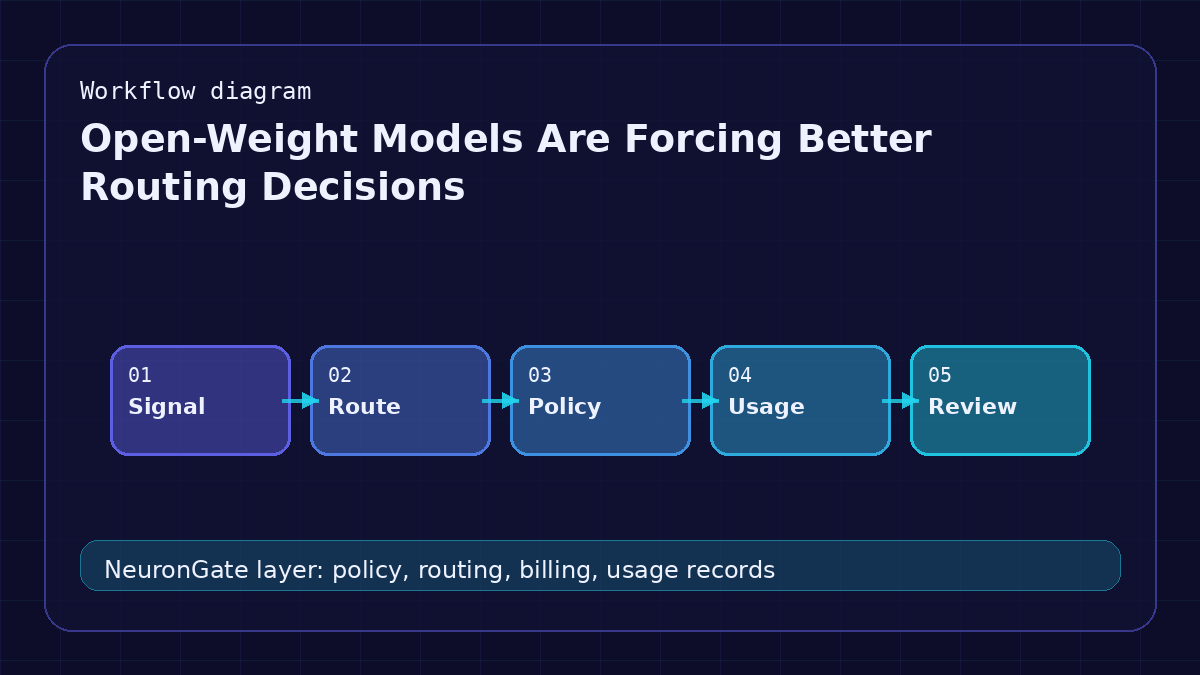
Open-weight releases are reshaping the economics of AI products in 2025. The interesting question is not whether every team should self-host. Most should not, at least not for every workload. The better question is which requests deserve managed frontier models, which can run on cheaper open routes, and which should move between them as quality improves.
This is a routing question before it is a model question.
Self-hosting is not free
Open weights reduce licensing friction, but they do not eliminate infrastructure work. A team still needs GPUs, deployment automation, monitoring, autoscaling, security patches, and incident response. If the workload is bursty, the hardware may sit idle. If the workload is latency-sensitive, placement matters. If the model needs frequent updates, operations get more complex.
For many companies, the right answer is hybrid. Use managed providers for reliability and frontier quality. Use open routes for predictable high-volume tasks. Keep the API shape stable so the application does not care which path handled a given request.
Cost pressure is healthy
Open models create pricing pressure across the market. That is good for developers, but only if their architecture can respond. If every model choice is hardcoded into the app, switching becomes a project. If the gateway owns model metadata and routing policy, switching becomes an operational decision.
A useful gateway can answer:
- which model is cheapest for this quality tier?
- which provider is healthy right now?
- which keys are allowed to use open routes?
- how do we compare output quality before migration?
- what happens if the open route fails?
Open routes need the same accounting
Cheaper does not mean unmetered. Users still need usage logs, cost estimates, and balance reservations. Internal teams still need to know which customer created which load. Finance still needs reports. Security still needs audit trails.
The mistake is treating open models as a side door. If a workload runs outside the normal gateway path, it often loses the controls that made production safe in the first place.
The likely future is mixed
The market is moving toward a mixed model stack: frontier APIs for the hardest work, fast hosted models for product flows, open-weight models for cost-sensitive tasks, and specialized models for domain needs. That mixed stack needs one stable interface.
NeuronGate is built for that future. We care less about declaring one winner and more about making model movement safe. When open models improve, developers should benefit without rebuilding their billing, auth, and observability layers from scratch.
Route fit matrix
A new model should be evaluated against specific workloads, not against the whole product. Good candidates include coding assistance, support escalation, long-context review, multimodal analysis, extraction, classification, and background summarization. Each workload deserves its own target for cost, latency, quality, and failure behavior.
For Open-Weight Models Are Forcing Better Routing Decisions, the first question is route fit. If the model is better but slower, use it for background or premium lanes. If it is faster but less capable, use it for high-volume preprocessing. If it is stronger and more expensive, make access intentional instead of default.
Production rollout notes
- Add the model as disabled or internal-only first.
- Attach pricing and context information before the first customer call.
- Compare it against the current route on real tasks, not only benchmark summaries.
- Keep a rollback model available for each customer-facing lane.
- Document the route in public content if customers may search for it.
FAQ
When should this model become default?
Make it default only after it wins on the actual workload. A model can be excellent for coding and still be the wrong default for fast customer chat or cheap classification.
Why mention the model in NeuronGate content?
Model-specific pages and articles help developers searching for current model names discover the gateway use case: access is useful, but governed access with billing and logs is what production teams need.
Route design for Open-Weight Models Are Forcing Better Routing Decisions
New model coverage should always answer one buyer question: where does this model belong in production? For August 2025, the answer starts with new frontier model launch discipline, effort controls, and staged default changes. The model may be stronger, faster, cheaper, or safer for some jobs, but it should still enter the product as a controlled route with pricing, permissions, limits, and a fallback.
The risk is that customers expect the latest model immediately while the production team still has no acceptance baseline. The API platform lead should compare evaluation win rate, regressions by workload, latency delta, opt-in usage, and rollback frequency against the current default before expanding access. This is especially important when the model name itself becomes a customer request. Public demand is useful, but it should not override route-level evidence.
Evaluation prompt set
Use one short prompt, one long-context prompt, one tool-heavy prompt, one failure-recovery prompt, and one real customer support prompt. Keep the grading rubric stable across old and new routes. If the new route wins only on one class of work, expose it only there. If it wins broadly and the cost model works, then update the default with a dated rollback note.
Also test the boring paths: invalid model ID, low balance, provider timeout, and blocked customer key. New model launches fail in those edges more often than in the happy-path demo. A practical next step is to compare routes in the model catalog, wire one request through the docs, then review the request path in the routing guide.