Year-End Model Audit Checklist for AI APIs
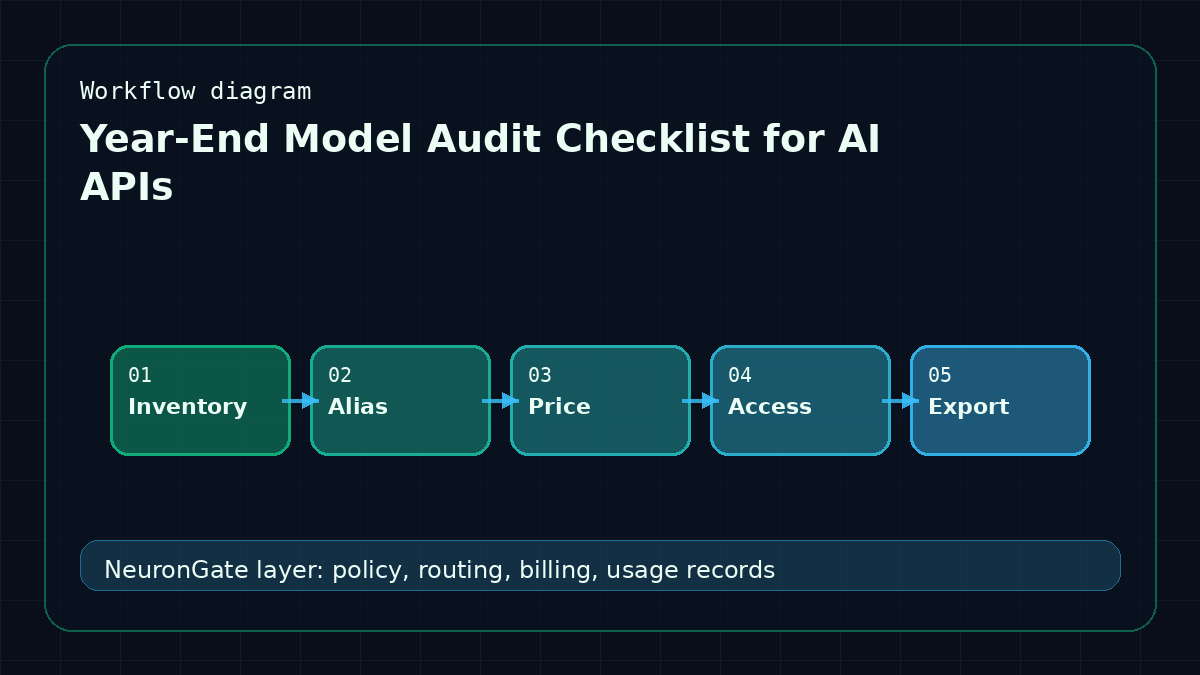
A model catalog can drift faster than most teams expect. In November 2025, this mattered because by november, many products had added experiments, deprecated models, temporary fallbacks, and special customer pins. The practical response was simple: list every active model route, remove unused aliases, compare current pricing, and export per-customer usage for review.
Architecture problem
A model catalog can drift faster than most teams expect. The infrastructure issue was that by november, many products had added experiments, deprecated models, temporary fallbacks, and special customer pins. Once AI features have real users, this cannot be solved with comments, dashboard screenshots, or a spreadsheet of model names.
The durable pattern
List every active model route, remove unused aliases, compare current pricing, and export per-customer usage for review. The gateway should own request identity, model policy, route health, cost reservation, and usage settlement. The application should own user experience, business logic, and domain-specific data preparation.
Failure modes to avoid
- Hardcoded provider model names in multiple services.
- Fallbacks that change model class without an audit trail.
- Background jobs that bypass customer balance checks.
- Usage exports that cannot reconcile with provider billing.
- Logs that expose prompt content when route metadata would be enough.
NeuronGate angle
NeuronGate gives operators one model catalog and one usage ledger to audit instead of chasing every app repository. Use the model catalog to compare available routes and pricing; use the docs to start integration work; use the routing guide to see the request path end to end.
Architecture boundary
The key boundary is between product logic and model operations. Product logic decides what the user is trying to do. Model operations decide which route is allowed, how much balance is reserved, whether provider health is acceptable, and how usage is settled.
When this boundary is clean, teams can add new models or providers without rewriting the product. When it is messy, every model launch becomes a hunt through environment variables, SDK wrappers, and old cron scripts.
Production readiness checklist
- Keep provider aliases out of user-facing client code.
- Store model capabilities, pricing, status, and migration notes in one catalog.
- Treat self-hosted, provider-hosted, and marketplace-routed models as route types with the same accounting rules.
- Verify the sitemap, canonical URL, article schema, and RSS feed after every content deployment.
- Review usage records after route changes to catch unexpected cost or latency drift.
FAQ
What breaks first in weak AI infrastructure?
Usually observability. The model still answers, but the team cannot explain why a route was chosen, why it cost more, or which customer keys were affected during an incident.
Why does this belong in the blog?
Infrastructure articles attract builders who already feel the operational problem. They are high-intent readers for NeuronGate because they are searching for how to make AI APIs reliable, auditable, and easier to scale.
Production architecture note
Year-End Model Audit Checklist for AI APIs is an infrastructure problem because model calls now behave like product traffic, financial events, and compliance records at the same time. In November 2025, the important design question was new frontier model launch discipline, effort controls, and staged default changes. A clean architecture puts route choice, model metadata, balance checks, and usage settlement in one layer so every application does not reinvent the same controls.
The failure mode is that customers expect the latest model immediately while the production team still has no acceptance baseline. The API platform lead should track evaluation win rate, regressions by workload, latency delta, opt-in usage, and rollback frequency and review those signals after every route or provider change. The common mistake is switching the global default before testing model-specific parameters and fallback behavior.
Systems checklist
- Keep model IDs, aliases, prices, context windows, and status in a catalog.
- Reserve spend before the upstream call when customer balances are involved.
- Log the provider route separately from the customer-facing model name.
- Make fallback behavior explicit, including when not to retry.
- Publish clear docs so search visitors and AI answer engines can understand the route.
The strongest infrastructure articles become reference pages. They should help an engineer implement the pattern and help a buyer understand why the pattern belongs in a gateway. Use the model catalog to compare route availability, use the docs to test the API, and use the articles archive when you need more model and infrastructure context.