How NeuronGate Helps Teams Try Open Reasoning Models
Open reasoning models created opportunity, but also operational risk. In January 2025, this mattered because teams needed a way to experiment without exposing every app to provider churn. The practical response was simple: route a small internal key first, compare usage records, then widen model access only when the data supports it.
Buyer problem
Open reasoning models created opportunity, but also operational risk. Buyers feel this problem as cost uncertainty, provider churn, slow procurement, missing usage history, or unclear model access. The technical details matter, but the business pain is simple: AI spend and reliability need one owner.
Product promise
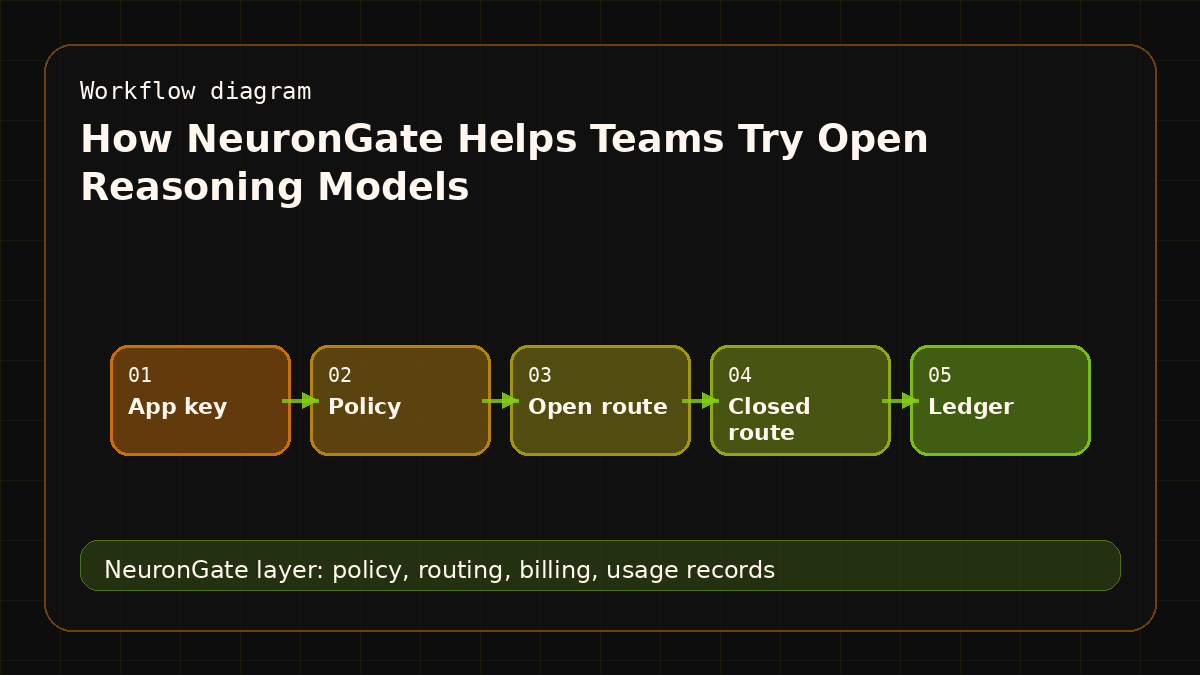
Teams needed a way to experiment without exposing every app to provider churn. Route a small internal key first, compare usage records, then widen model access only when the data supports it. A gateway should make the boring parts of AI operations visible: which key called which model, what it cost, whether it succeeded, and what policy allowed it.
Where NeuronGate fits
NeuronGate makes the gateway the stable contract while the model market changes underneath it. This is the marketing point worth repeating because it is also the technical point: one stable API surface lets teams adopt new models without rebuilding billing, auth, rate limits, and customer reporting for every provider.
What to do next
Use NeuronGate for the routes that need production controls: customer-facing assistants, internal agents, long-context analysis, model evaluations, and usage-based AI products. Use the model catalog to compare available routes and pricing; use the docs to start integration work; use the articles archive to browse more model and infrastructure context.
Conversion angle
The reader for this article is usually past curiosity. They are trying to ship an AI feature, reduce provider sprawl, avoid surprise invoices, or give customers cleaner usage history. The marketing job is to show that NeuronGate solves those operational problems without adding another complicated workflow.
That means the article should connect product value to engineering detail. One API is useful because it reduces integration work. A funded balance is useful because it controls spend. A model catalog is useful because teams can change routes without changing every client.
Buyer checklist
- Do you need more than one model provider?
- Do customers need usage history or invoices?
- Do internal agents need separate keys from production apps?
- Do you want crypto-funded AI access without subscription procurement?
- Do you need a public model catalog and docs that Google can index?
FAQ
Who is NeuronGate best for?
NeuronGate is best for teams building AI products that need model choice, usage-based billing, customer balances, and operational logs. It is especially useful when the team wants OpenAI-compatible access without being locked into one provider route.
What should a buyer do after reading?
A buyer should compare the model catalog, read the integration docs, and test one non-critical workflow through NeuronGate. That gives them cost and route visibility before moving important traffic.
Buyer context for January 2025
How NeuronGate Helps Teams Try Open Reasoning Models matters because buyers do not usually ask for a gateway in abstract terms. They ask why their AI spend is unclear, why one model change touches five codebases, why customer usage reports are late, or why procurement blocks a test that engineering could finish in an afternoon. This article connects that buyer pain to reasoning-model adoption, alias stability, and provider churn.
The risk is that a team adds the model quickly, then discovers that aliases, rate limits, or deprecation notices moved faster than its application release cycle. NeuronGate is positioned around the opposite pattern: one OpenAI-compatible API, one funded balance, one model catalog, one usage history, and route policy that operators can explain. The model ops lead can review route acceptance rate, alias error rate, retry volume, customer opt-in count, and cost per successful reasoning task without waiting for every application team to export its own logs.
NeuronGate marketing fit
This is the kind of article that should convert a high-intent reader. The reader already knows models are changing quickly. The marketing job is to show that NeuronGate makes that change adoptable: start with one internal key, prove the route, keep billing visible, then widen access only when the evidence supports it.
The page should not read like a slogan. It should show the route, the buyer problem, the operational evidence, and the next action. That is what makes a marketing article useful enough to index. For implementation work, start in the docs, confirm model access in the model catalog, and keep the routing guide open while you test.