The Agents SDK Era Needs Better API Boundaries
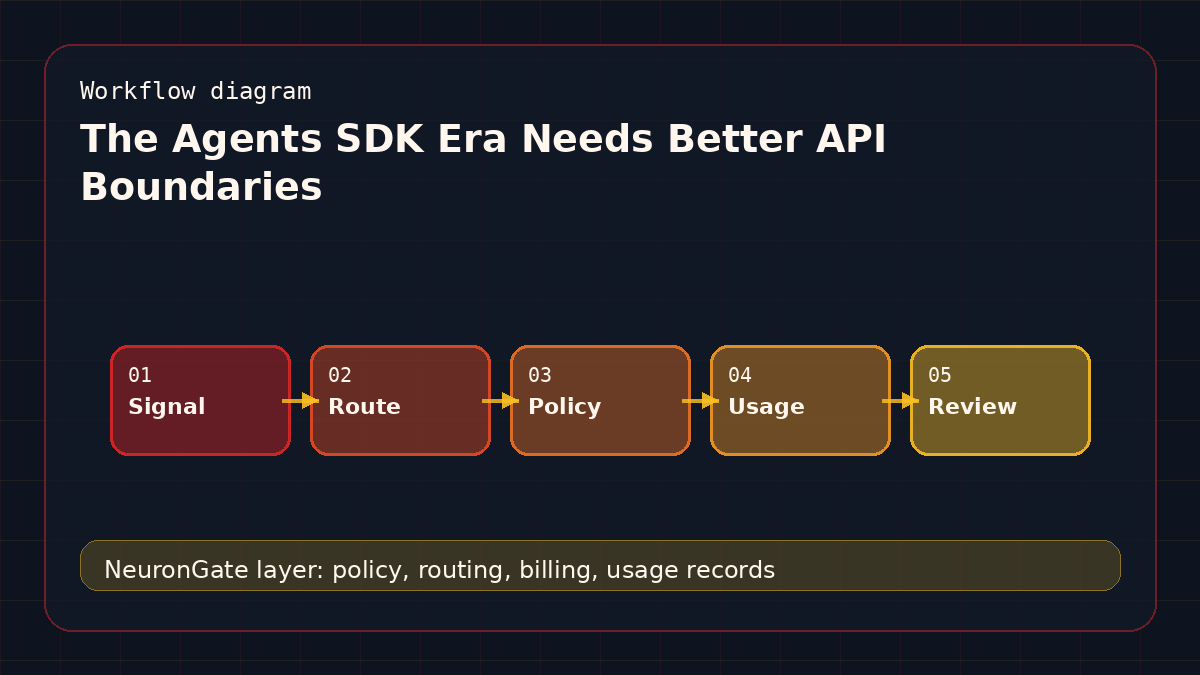
Agent frameworks are becoming normal developer infrastructure. The launch of new agent tooling this spring made one thing clear: teams are no longer sending a single prompt to a single model and calling it done. They are building workflows that plan, call tools, inspect results, retry, summarize, and sometimes hand work to another model.
That is powerful, but it changes the failure surface. A simple chat completion may cost a few cents and produce one response. An agent loop can make ten calls, hit multiple endpoints, and keep going after a partial failure. The model API is no longer just a text generator. It is part of a control system.
Agents multiply small mistakes
A bad default model choice is annoying in a chat app. In an agent workflow, it can become expensive. A missing timeout, a retry loop, or an overly broad tool instruction can turn one request into a cascade. The user may only see the final answer, but the platform sees every intermediate call.
That makes API boundaries important. Teams need to decide which keys can use which models, how much monthly spend a key can create, and what happens when the upstream provider fails. Those decisions should live in infrastructure, not inside every agent script.
The gateway becomes the policy layer
A good gateway can enforce rules before an agent loop gets out of hand. For example:
- a staging key can use experimental models, but a production key cannot
- an agent worker can have a monthly cap separate from the main application
- high-latency reasoning models can be restricted to background jobs
- provider errors can be normalized before they hit the framework
- usage can be logged per request ID, not guessed from app logs later
These are not glamorous features. They are the difference between a prototype and a system that a finance team can tolerate.
Model choice should be workload choice
Agent stacks also make it obvious that no single model should do everything. A workflow might use a fast model to classify an incoming task, a reasoning model to plan, a coding model to edit, and a cheaper model to summarize. Hardcoding one provider across that whole chain leaves money and reliability on the table.
The better pattern is to treat model selection as part of orchestration. The app describes what it needs. The gateway and policy layer decide what is allowed, what is healthy, and what is affordable.
Observability is not optional
When an agent fails, the team needs to know where. Did the classifier choose the wrong route? Did the planner burn too many tokens? Did a provider return a 500? Did the final summarizer hide an upstream error? Without request-level logs, agent debugging becomes folklore.
This is why NeuronGate keeps usage history, request IDs, and provider-aware routing in the core architecture. Agents will make AI apps more useful, but they also make invisible infrastructure visible. The safest way to build with them is to put boundaries around the loop before the loop surprises you.
Signals to watch next
The useful follow-up is not whether the announcement stays popular for a week. Watch whether provider pricing changes, whether aliases move, whether rate limits tighten, and whether customers ask for access by name. Those signals show when a news event has become product demand.
Teams should also watch support tickets. If customers ask why they cannot call a model, why an answer changed, or why one request costs more than another, the gateway needs clearer policy and better public documentation.
Editorial position
NeuronGate should treat news as operational context, not hype. A model release, compliance deadline, developer framework, or infrastructure announcement only matters when it changes how teams route, bill, observe, or explain AI work.
FAQ
Does this news require an immediate migration?
Usually no. The better response is to add the event to the evaluation backlog, map the affected workloads, and test behind controlled keys before changing defaults.
How does this help search visibility?
News-aware articles give Google and AI answer engines dated context around specific model and infrastructure events. That is stronger than generic evergreen copy because it shows freshness, source awareness, and product interpretation.
Why this mattered in March 2025
The news value of The Agents SDK Era Needs Better API Boundaries was operational, not just narrative. Teams could read OpenAI Agents SDK guide and understand the announcement, but builders needed a second layer: what changes in routing, policy, billing, and customer communication. The central concern was AI route governance, customer-visible reliability, and usage-based product operations. That is why this article frames the event through gateway operations instead of treating it as another model-market headline.
The practical risk was that model choice changes faster than the product, leaving billing, support, and documentation behind. A strong gateway response is measured by successful requests, settled cost, latency, fallback share, support tickets, and route-level margin. That gives the AI platform owner a way to decide whether the event requires a catalog update, a customer notice, an internal evaluation, or no immediate production change.
Editorial filter
NeuronGate should not chase every announcement. It should cover the events that change how teams build AI products: new model access, provider deprecation, pricing movement, latency changes, compliance pressure, and infrastructure shifts. The Agents SDK Era Needs Better API Boundaries qualifies because it gives buyers and engineers a dated reason to review their AI API operating model.
The publication note is simple: keep the date visible, link the source, state the operational takeaway early, and connect the story to a concrete routing or logging action. The model catalog is the operational reference, the docs are the integration path, and the articles archive gives the dated context behind each routing decision.