The EU AI Act Code of Practice Is an API Problem Too
Europe's AI governance work became more concrete this summer as general-purpose AI guidance moved from abstract debate toward operational expectations. Legal teams will read the details differently than engineers, but one thing is already clear: compliance pressure eventually lands in the API layer.
That does not mean every startup needs a compliance department on day one. It means teams should stop treating model calls as invisible. If an application depends on external models, the system needs to know what was called, when, by whom, and under which policy.
Logs become evidence
For many AI products, the only durable record of a model call is an application log line or a provider invoice. That is not enough when customers ask about data flows, model provenance, or incident timelines. A gateway can provide a cleaner source of truth.
Useful records include:
- request ID
- account and API key identity
- model and provider
- timestamp and latency
- token usage and billed cost
- error class, if any
- policy decisions such as allowlist denial
These records help with debugging today and governance tomorrow.
Provider choice becomes a policy decision
Regulatory pressure also changes how teams think about providers. Some workloads may require specific regions, contractual terms, or model families. Some internal tools may be allowed to use experimental models while customer-facing features stay on approved routes.
The important part is separating application code from policy. Developers should not have to fork the app to comply with a new customer requirement. A gateway should let the team change which models are available to which keys without redeploying every client.
Documentation has to match behavior
Compliance work breaks down when docs say one thing and production does another. If a pricing page lists a model, but the API routes to a different provider during fallback, that needs to be understood and logged. If an error response hides provider details for security, internal logs still need enough context for audit.
This is why API consistency matters. Error shapes, billing behavior, and model names should be predictable. Surprises are expensive when legal and enterprise customers get involved.
Build the boring controls early
The EU AI Act will not be the only governance regime that matters. Customers, insurers, cloud marketplaces, and internal security teams will all ask their own versions of the same questions. The cheapest time to build traceability is before the product has hundreds of integrations.
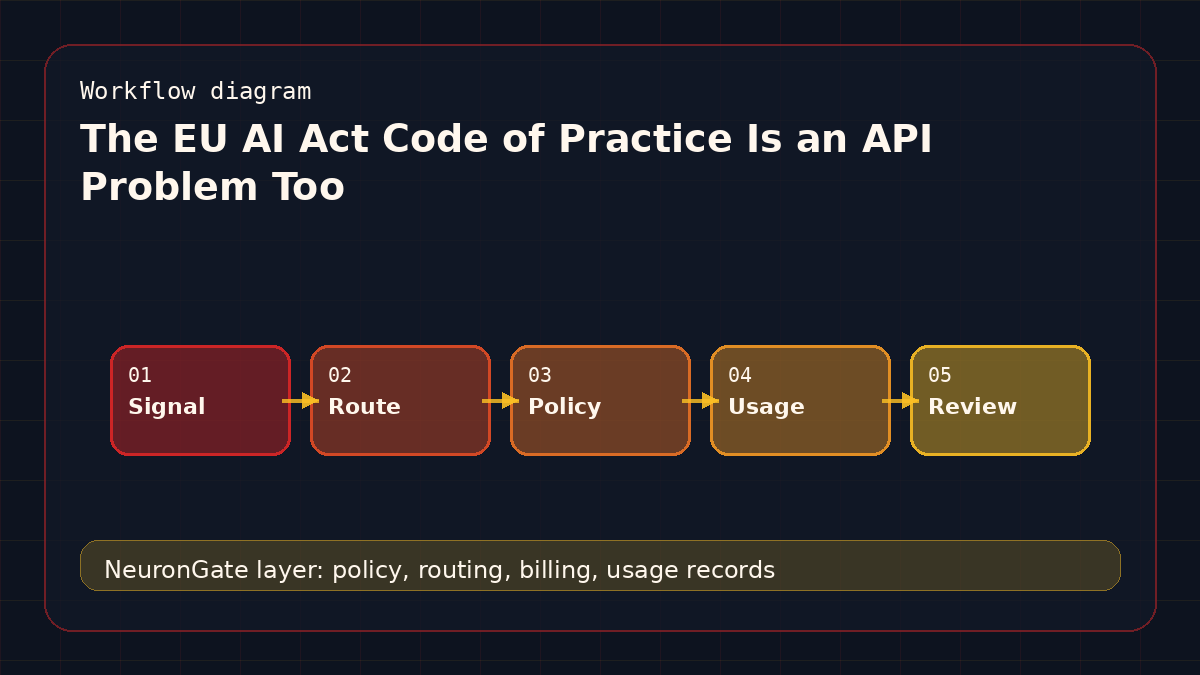
NeuronGate is taking the boring path intentionally: stable request IDs, usage logs, model metadata, balance controls, and policy-aware routing. The goal is not to turn every developer into a compliance expert. It is to make the infrastructure less chaotic when compliance questions arrive.
Signals to watch next
The useful follow-up is not whether the announcement stays popular for a week. Watch whether provider pricing changes, whether aliases move, whether rate limits tighten, and whether customers ask for access by name. Those signals show when a news event has become product demand.
Teams should also watch support tickets. If customers ask why they cannot call a model, why an answer changed, or why one request costs more than another, the gateway needs clearer policy and better public documentation.
Editorial position
NeuronGate should treat news as operational context, not hype. A model release, compliance deadline, developer framework, or infrastructure announcement only matters when it changes how teams route, bill, observe, or explain AI work.
FAQ
Does this news require an immediate migration?
Usually no. The better response is to add the event to the evaluation backlog, map the affected workloads, and test behind controlled keys before changing defaults.
How does this help search visibility?
News-aware articles give Google and AI answer engines dated context around specific model and infrastructure events. That is stronger than generic evergreen copy because it shows freshness, source awareness, and product interpretation.
Why this mattered in July 2025
The news value of The EU AI Act Code of Practice Is an API Problem Too was operational, not just narrative. Teams could read EU GPAI Code of Practice and EU AI Act overview and understand the announcement, but builders needed a second layer: what changes in routing, policy, billing, and customer communication. The central concern was compliance-ready usage logs, public policy language, and evidence retention. That is why this article frames the event through gateway operations instead of treating it as another model-market headline.
The practical risk was that the company says it has AI governance but cannot reconstruct which model handled a customer request. A strong gateway response is measured by log completeness, source citation coverage, policy exception count, retention status, and customer export time. That gives the compliance owner a way to decide whether the event requires a catalog update, a customer notice, an internal evaluation, or no immediate production change.
Editorial filter
NeuronGate should not chase every announcement. It should cover the events that change how teams build AI products: new model access, provider deprecation, pricing movement, latency changes, compliance pressure, and infrastructure shifts. The EU AI Act Code of Practice Is an API Problem Too qualifies because it gives buyers and engineers a dated reason to review their AI API operating model.
The publication note is simple: keep the date visible, link the source, state the operational takeaway early, and connect the story to a concrete routing or logging action. The model catalog is the operational reference, the docs are the integration path, and the articles archive gives the dated context behind each routing decision.