Blackwell Supply Is Already Showing Up in API Strategy
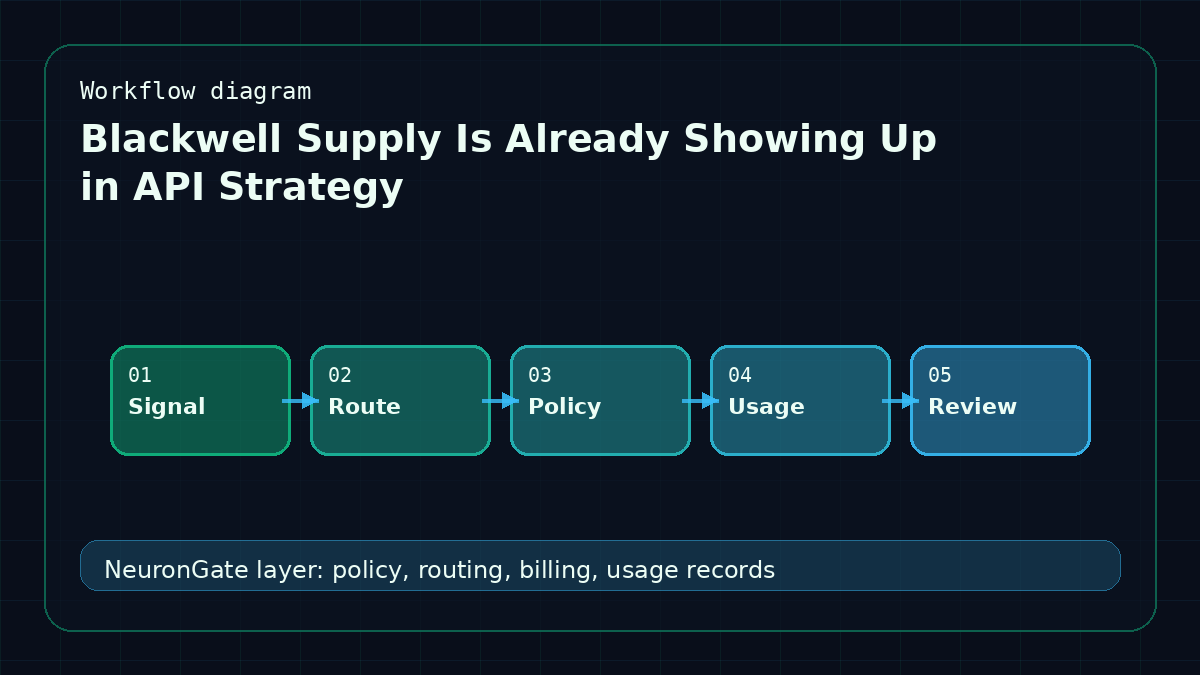
The GPU supply conversation can feel far away from API developers, but it eventually reaches them through pricing, latency, and availability. As Blackwell-era capacity starts shaping provider roadmaps, teams building AI products are asking whether today's model costs and rate limits will still make sense six months from now.
The answer is probably no. That is why flexibility matters.
Hardware cycles become product cycles
When more efficient hardware reaches providers, the effects are uneven. Some models get cheaper. Some get faster. Some providers pass savings through quickly. Others use capacity for new premium tiers. Regional availability may improve in one place and remain tight in another.
If an application is tied to one provider and one model string, it cannot react quickly. If routing is centralized, the team can test new price-performance options without changing every client.
Capacity affects reliability
Provider incidents are not always software bugs. Sometimes capacity is the bottleneck. A model may be healthy for small requests and unreliable for long-context jobs. A region may degrade during peak demand. A new release may attract enough traffic to change latency overnight.
This is why health tracking should be model-aware. A generic "provider up" status is too coarse. Teams need to know which routes are performing well for their actual workloads.
Pricing needs guardrails
Lower prices can encourage more usage, which is good until a runaway job burns through budget. Higher-end models can deliver better results, but only when the task deserves them. The right infrastructure pattern combines model choice with spend controls.
For example:
- set monthly caps per API key
- reserve estimated cost before dispatch
- settle exact usage after completion
- expose usage history to the customer
- alert when a route becomes unusually expensive
These controls matter regardless of which GPU generation is under the provider's datacenter.
Build for movement
The next year of AI infrastructure will not be static. Hardware changes, model releases, and provider competition will keep changing the best route for a given task. Developers should not have to rebuild their product every time the market moves.
NeuronGate's position is simple: the AI API should be stable even when the model market is not. Hardware cycles will keep changing the economics. A gateway gives teams somewhere safe to adapt.
Architecture boundary
The key boundary is between product logic and model operations. Product logic decides what the user is trying to do. Model operations decide which route is allowed, how much balance is reserved, whether provider health is acceptable, and how usage is settled.
When this boundary is clean, teams can add new models or providers without rewriting the product. When it is messy, every model launch becomes a hunt through environment variables, SDK wrappers, and old cron scripts.
Production readiness checklist
- Keep provider aliases out of user-facing client code.
- Store model capabilities, pricing, status, and migration notes in one catalog.
- Treat self-hosted, provider-hosted, and marketplace-routed models as route types with the same accounting rules.
- Verify the sitemap, canonical URL, article schema, and RSS feed after every content deployment.
- Review usage records after route changes to catch unexpected cost or latency drift.
FAQ
What breaks first in weak AI infrastructure?
Usually observability. The model still answers, but the team cannot explain why a route was chosen, why it cost more, or which customer keys were affected during an incident.
Why does this belong in the blog?
Infrastructure articles attract builders who already feel the operational problem. They are high-intent readers for NeuronGate because they are searching for how to make AI APIs reliable, auditable, and easier to scale.
Production architecture note
Blackwell Supply Is Already Showing Up in API Strategy is an infrastructure problem because model calls now behave like product traffic, financial events, and compliance records at the same time. In March 2025, the important design question was catalog design, migration planning, and fallback ladders. A clean architecture puts route choice, model metadata, balance checks, and usage settlement in one layer so every application does not reinvent the same controls.
The failure mode is that model metadata lives in code comments while pricing, aliases, and status change in production. The API infrastructure owner should track catalog freshness, fallback usage, migration error rate, latency by tier, and unsupported model requests and review those signals after every route or provider change. The common mistake is treating model choice as a constant instead of product data.
Systems checklist
- Keep model IDs, aliases, prices, context windows, and status in a catalog.
- Reserve spend before the upstream call when customer balances are involved.
- Log the provider route separately from the customer-facing model name.
- Make fallback behavior explicit, including when not to retry.
- Publish clear docs so search visitors and AI answer engines can understand the route.
The strongest infrastructure articles become reference pages. They should help an engineer implement the pattern and help a buyer understand why the pattern belongs in a gateway. Use the model catalog to compare route availability, use the docs to test the API, and use the articles archive when you need more model and infrastructure context.